More Camino; Less Stuff
Carry Less, Experience More
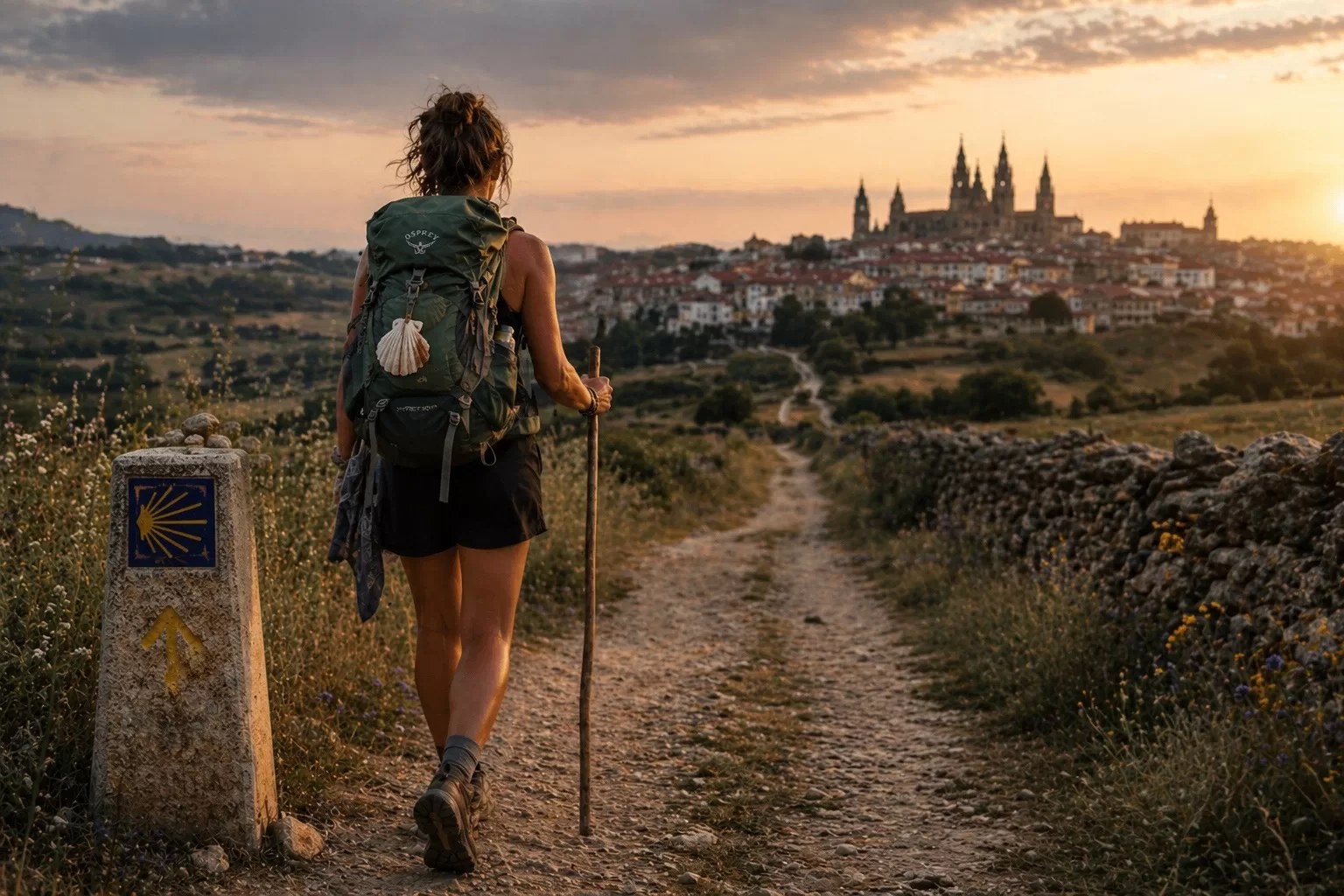
The Camino de Santiago is a pilgrimage/walking route across northern Spain, France, and Portugal (among other countries) but for many women over 50 it becomes something far more intimate than a trail. It becomes a deliberate simplification of life. A long-form experiment in what remains when everything unnecessary is removed.
More Camino. Less stuff. Less identity clutter. More direct experience of being alive in a body that is still capable, still adaptive, still curious.
* Some links in this article are affiliate links. If you choose to purchase through them, I may earn a small commission at no extra cost to you. I only share gear I genuinely find useful for lightweight travel and backcountry adventures.
Why a 50+ woman walks the Camino
There is a particular moment in midlife when the internal question changes shape. It is no longer about achievement, accumulation, or proving. It becomes something quieter and more precise.
What actually matters now?
For women in their 50s, 60s, and beyond, the Camino de Santiago often arrives as a response to that question rather than a goal in itself.
Some women come after endings. Divorce. Loss. Retirement. Children grown and gone. A long chapter closing.
Others come after success, but find that success alone does not translate into aliveness.
And some come simply because a deeper instinct emerges that says:
I want to walk my life back into my body.
This is where solo female travel becomes especially significant. Walking alone across Spain or Portugal, or connecting segments of the Camino Pilgrim experience, is not about independence as a concept. It is about direct contact with self without constant relational negotiation.
There is no role to perform on the Camino. No title to maintain. No audience to manage.
There is only walking.
And for many women practicing mindful aging, that simplicity is not just appealing. It is corrective.
The Camino as a reset for modern nervous systems
The modern nervous system is often overstimulated, over-scheduled, and over-accommodated by convenience. Even rest has become curated.
The Camino interrupts this pattern.
It offers a radically consistent rhythm:
Wake. Walk. Eat. Sleep. Repeat.
This repetition is not boring. It is regulating.
Over time, the body begins to recalibrate. The mind quiets not because it is forced to, but because it is no longer being constantly recruited by external input.
In this way, the Camino becomes a kind of moving sanctuary for women interested in mindful aging. Not as a philosophy, but as an embodied experience.
The terrain itself participates in this regulation. Long stretches of trail. Repetitive footfalls. Weather that cannot be controlled. Conversations that come and go without obligation.
It is a return to something ancient in the human system: forward motion through landscape as a way of integrating experience.
Ultralight as philosophy, not just gear
Ultralight backpacking is often discussed in terms of grams and gear lists. But for the Barefoot Chica, ultralight is also psychological and emotional.
Every object carried on the Camino is a small commitment of attention.
Every “just in case” item is a projection into a future that may never arrive.
When women choose an ultralight Camino de Santiago approach, something deeper is happening than convenience. They are choosing to trust adaptability over preparedness.
They are choosing responsiveness over control.
This matters especially in midlife and beyond, when many women begin to notice how much energy has been spent anticipating other people’s needs, moods, and outcomes.
Ultralight walking interrupts that pattern.
It quietly teaches:
You can meet what comes without carrying everything in advance.
This is not recklessness. It is a form of embodied intelligence.
Backpacking Spain and Portugal as threshold spaces
The Camino routes through Spain, and the growing interest in the Portugal sections of the broader pilgrimage network, offer something unique: transitional geography.
These landscapes are not static destinations. They are passageways.
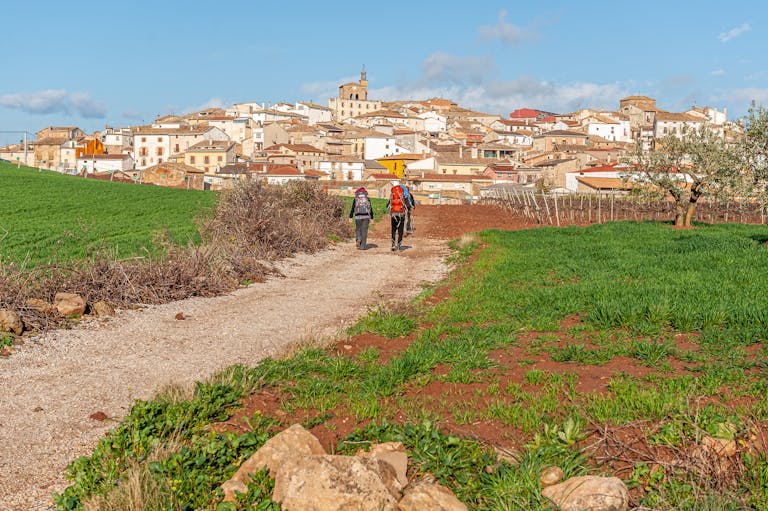
Small villages. Long agricultural stretches. Coastal edges. Forest corridors. Stone paths worn by centuries of movement.
For women walking solo, these environments become psychologically significant. They are safe enough to move through, but not so structured that they dictate experience.
This balance matters.
Too much structure and the journey becomes managed.
Too little structure and it becomes chaotic.
The Camino sits in a rare middle space where autonomy and safety coexist.
For many women practicing solo female travel later in life, that balance is what makes the experience sustainable.
The Camino Pilgrim experience as identity dissolution
There is a moment, usually after several days of walking, when identity begins to loosen.
Not in a dramatic way.
In a quiet one.
You stop being the person with a defined life back home and start becoming the person who is simply walking today’s stage of trail.
This is the essence of the Camino de Santiago Pilgrim experience.
You are no longer primarily your roles.
You are your footsteps.
Your pace.
Your breath.
Your willingness to continue.
This is not escapism. It is clarity.
Because when identity softens, perception sharpens.
You notice small things again. The sound of gravel underfoot. The shift of light across a field. The sensation of hunger before it becomes a distraction.
These are not romantic details. They are nervous system re-anchoring points.
Why less stuff creates more presence
One of the most consistent discoveries women report on the Camino is that reducing possessions increases perception.
This is not metaphorical.
It is neurological.
Fewer decisions about gear mean more attention available for environment, body, and internal state.
Fewer physical burdens mean more sensory bandwidth.
Fewer contingencies mean more presence in what is actually happening.
“Less stuff” is not aesthetic minimalism. It is functional freedom.
It creates space for something more valuable than preparedness:
responsiveness
The emotional landscape of walking alone
Walking alone for days or weeks introduces a different emotional tempo.
Loneliness may arise, but so does spaciousness.
Silence is no longer absence. It becomes context.
For many women over 50, especially those who have spent decades in relational density, this shift can feel both unfamiliar and restorative.
There is room for grief to surface without interruption.
There is room for joy that is not socially mediated.
There is room for simply existing without explanation.
This is where mindful aging becomes tangible rather than conceptual.
It is not about resisting age. It is about refining relationships with attention, body, and time.
The quiet rebellion of choosing less
There is a subtle cultural expectation that later life should become more comfortable, more settled, more contained.
The Camino offers an alternative narrative.
It suggests that later life can also be more expansive, more mobile, more self-directed.
Choosing ultralight travel. Women choosing solo travel. Choosing to walk long distances across whole countries.
These are not retreats from life.
They are re-entries into it with fewer filters.
For some women, this feels like rebellion.
But it is not loud rebellion.
It is quiet.
It looks like:
- A small backpack instead of a suitcase
- A simple walking rhythm instead of a packed schedule
- A willingness to be uncertain without needing to resolve it immediately
This is the Barefoot Chica way. The Feral Crone way.
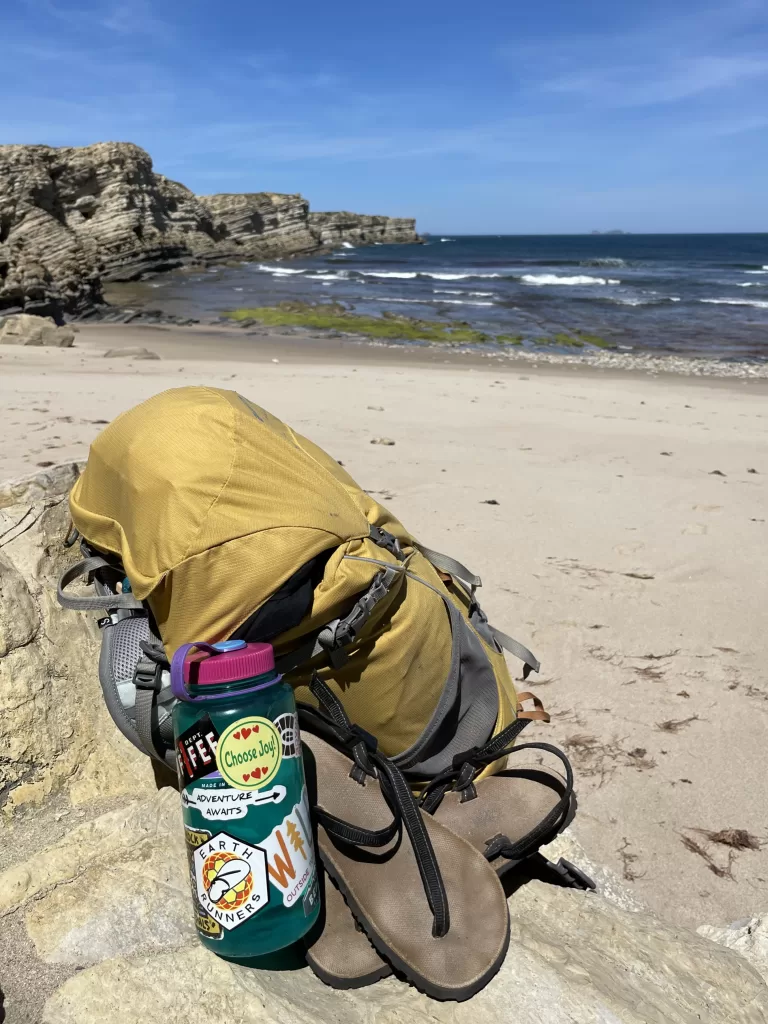
Closing reflection: what remains
At some point on the Camino, the question shifts again.
Not what am I carrying?
But what is actually necessary to continue?
And the answer becomes increasingly simple.
A body that can walk.
Food when needed.
Rest when needed.
A path that continues forward.
Everything else is optional.
That is the essence of More Camino; Less Stuff.
Not as a rule.
But as a lived experiment in what happens when a woman chooses to travel lightly, move slowly, and trust that she is already enough for the road ahead.
Further Reading: What I Actually Carried on the Camino (and What I Didn’t Need)